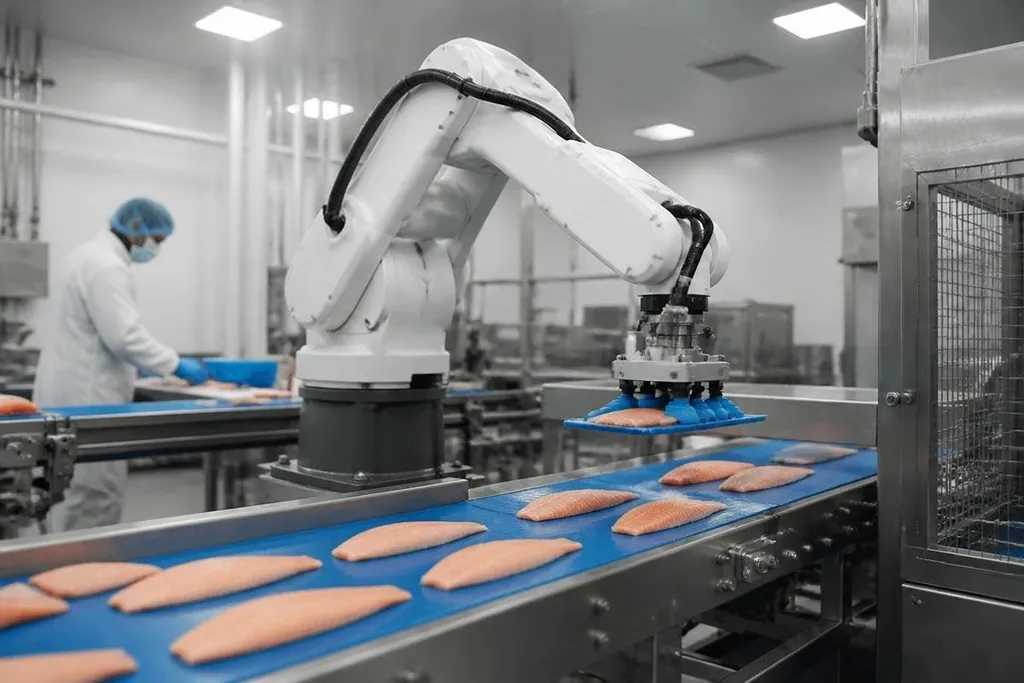
A food robot can repeat the same movement for hours, but that alone doesn’t make food safer. The useful question is where a machine can control a task, record what happened, and reduce contact with food or equipment.
- Cameras can check shape, color, and surface defects before packing.
- Robotic arms can handle repetitive work with a fixed motion and set force.
- Digital records can connect a batch to its checks, cleaning steps, and operator settings.
Where robots can reduce risk
Food work includes repeated lifting, cutting, sorting, filling, and packing. A robot can run these motions inside a defined area, which may reduce the number of times people reach into a process or handle finished food.
That benefit depends on the machine’s design. A gripper that is hard to clean can create a new hygiene problem. If the robot drops food, damages packaging, or misses a fault, it can lower quality while appearing consistent.
The safer setup uses food-grade contact parts where needed, smooth surfaces, controlled access, and cleaning steps that staff can inspect. The robot’s motion matters, but the parts around it matter too.
How machines can check quality
A camera system can inspect features such as size, color, shape, fill level, seal position, or visible damage. The software compares each item with set limits and sends items outside those limits for review or removal.
That check works best when the target is clear. A vision system can find a missing label more easily than it can judge whether a prepared meal looks appealing. Lighting, camera position, food movement, and packaging all affect the result.
Robots can also keep a steady speed and force during tasks such as placing items in trays or closing packages. A fixed motion may reduce variation, but it doesn’t remove the need for sampling and human checks. Food changes with temperature, moisture, shape, and size.
Records matter as much as motion
A robotic line can record which batch it handled, when a check happened, and which settings were active. Those records can help a food team find the point where a problem started, provided the system connects its data to the wider production process.
A food robot matters only if it works in a live line and leaves records staff can check. A report on Robot24.com can show the test setup, the robot’s task, and the human checks around it. A smooth demo says little about batch records or sensor errors, which is why the next step is checking how the system handles bad data.
Data also needs care. An incorrect sensor reading can enter the record without warning. Staff need a clear way to spot missing data, pause the line, and check the food by another method.
The limits food teams need to plan for
Robots work best when the task stays within known limits. Loose products can shift. Soft food can deform under pressure. Sticky ingredients can change how a gripper releases an item. Packaging can reflect light in ways that confuse a camera.
Cleaning is another test. A robot may handle food well during production, then lose that advantage if staff cannot reach a joint, cable, or tool mount for inspection. The cleaning method must match the materials, seals, and sensors in the cell.
People still need to set the limits, inspect results, deal with faults, and decide when a process needs to stop.
Training should cover the robot, the food hazard, the sensors, and the manual fallback. A machine that cannot be safely paused belongs on a review list before it reaches production.
A buying checklist
Use these checks before selecting a food robot:
- Name the task: Write down the motion, food type, contact points, speed, and acceptable error.
- Check the clean-down: Ask staff to inspect every food-contact surface, joint, seal, and tool change point.
- Test the full range: Run products at their smallest, largest, coldest, warmest, wettest, and driest expected conditions.
- Review the records: Confirm that the system stores batch, inspection, fault, and operator data in a form the team can use.
- Plan the stop: Set out who can pause the cell, how food is held, and how work resumes after a fault.
The case for food robots rests on a narrow claim: a controlled task can reduce variation and limit handling when the whole cell supports that goal. The next question for any buyer is whether the machine can keep that control through cleaning, product changes, sensor faults, and a full production shift.